Tuesday, September 4, 2018

He gave up too early


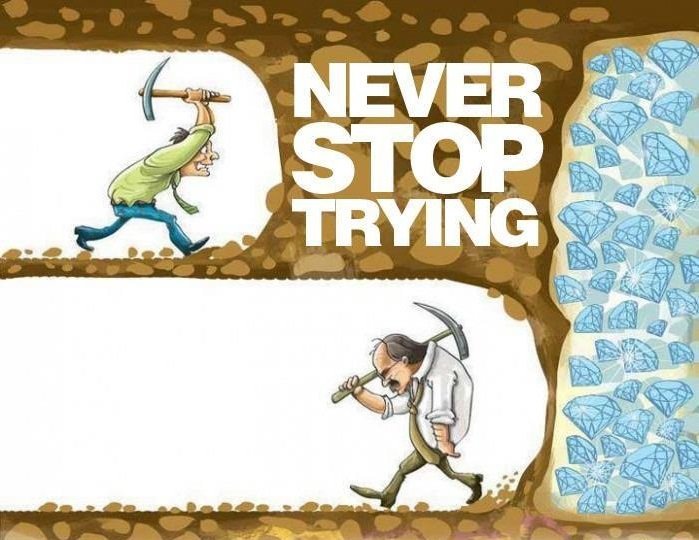
Image result for he gave up too earlyThere are many tactics Satan uses to stop Christians from reaching heaven, but rarely are any of his tactics more effective than discouragement.  The poor man in the lower half of this picture was most likely focused on his blisters, his aching muscles, and how much work he had put in with absolutely no reward.  He was only inches from a great reward which by comparison would have made his labor seem like a momentary inconvenience!  While he walks away disappointed, however, the man in the top tunnel is pressing on.  He likely has the same blisters and the same sore muscles.  He has been digging about the same distance as Mr. Discouragement, below him.  What makes him different?

2 Corinthians 4:16-18
           Therefore we do not lose heart, but though our outer man is decaying, yet our inner man is being renewed day by day. For momentary, light affliction is producing for us an eternal weight of glory far beyond all comparison, while we look not at the things which are seen, but at the things which are not seen; for the things which are seen are temporal, but the things which are not seen are eternal.

Paul spoke to the church at Corinth concerning perseverance.  The theme of the letter could easily be "do not give up!"  With great emotion Paul discusses the hardships of ministry, in hope that the Corinthians would follow his example of "not losing heart," 4:1.  The message was doubtless encouraging to the Christians of the day, and it can give the same encouragement to us.  While Paul dealt with all manner of trouble (see 2 Corinthians 11:23-28), he called it "light affliction," and refused to give up.  Few of us, if any, have faced the dangers and challenges that Paul faced.  If Paul can persevere, we most certainly can, too!

If only the man in the bottom tunnel had swung his pick a few more times...

What have we lost by giving up too early?  How many challenges have we allowed to beat us because we focused on the hurt instead of heaven?  

Let us remember that as we face troubles in this lifespan, we are only comparative moments from an eternity with God where there will be no sorrow, no tears, no sickness, and no death!  If we keep swinging the pick, we can one day look Jesus in the eye!  If we keep going, we will possess a reward that will make the hard things in this life seem like trifles rather than trials!  

2 Corinthians 4:8-10
           We are afflicted in every way, but not crushed; perplexed, but not despairing; persecuted, but not forsaken; struck down, but not destroyed; always carrying about in the body the dying of Jesus, so that the life of Jesus also may be manifested in our body.

Keep the faith. :-)
J

Tuesday, August 28, 2018

The Diode

Image result for diode

(Story concept courtesy of Dan Schnell)

Bobby excitedly ripped open the brown paper packaging of his long-awaited delivery.  He got goosebumps as he laid out the different components of his do-it-yourself radio kit.  The twelve-year-old young man shut himself in the work shed and meticulously set up his work area.  He entertained the idea of tuning in to the different radio waves with his homemade device as he soldered the circuit board and branded the words "sound box" on the rough cedar casing.  The dials were tight, and the power switch snapped on and off with a sharp *click*.  Bobby licked his lips and anticipated the soft hum of electricity as he plugged in his new radio, but when he plugged it in, nothing happened.  The lights did not come on, and the soft crackle of the airwaves was conspicuously absent.  He flipped the power switch a few times, and even tried different electrical outlets to no avail.  As Bobby regarded the useless radio and considered the hours he'd spent assembling it, he threw it to the ground and stomped on the casing, shouting as it crunched beneath his boot. After shedding a few tears of frustration, he picked up his ruined radio and began laying out the smashed components, trying to understand why his project had failed.  Through checking and rechecking with the instructions, Bobby noticed a tiny diode that he'd soldered hours before.  Wasn't the black side supposed to be soldered to the black wire?  It was backwards!  Bobby disconnected the little part and soldered it in the correct position, then connected the wiring to electricity.  The speaker crackled and the plucking of a banjo permeated the atmosphere in the work shed.  All because the tiniest part of the radio was inverted, the entire appliance had failed to function.  

Ephesians 4:11-16

           11        And He gave some as apostles, and some as prophets, and some as evangelists, and some as pastors and teachers,
           12       for the equipping of the saints for the work of service, to the building up of the body of Christ;
           13       until we all attain to the unity of the faith, and of the knowledge of the Son of God, to a mature man, to the measure of the stature which belongs to the fullness of Christ.
           14       As a result, we are no longer to be children, tossed here and there by waves and carried about by every wind of doctrine, by the trickery of men, by craftiness in deceitful scheming;
           15       but speaking the truth in love, we are to grow up in all aspects into Him who is the head, even Christ,
           16       from whom the whole body, being fitted and held together by what every joint supplies, according to the proper working of each individual part, causes the growth of the body for the building up of itself in love.

As we consider the story of the diode, we must ask if we recognize ourselves in the account.  Are we Bobby, who fails to see the backward diode?  This would be the Christian who fails to recognize that someone in the congregation has an issue and needs our attention.  Or are we the diode, a Christian who sees so many problems in the church and wonder why nothing works, while we are actually the source of the problem?

Let us work, both to be mindful of each part of the body, and to make sure that we are a faithful part of the body.

J


Tuesday, August 14, 2018

To Be Encouraged...

Image result for first bike ride

Very nearly every adult in the United States remembers learning how to ride a bicycle.  The usual method involves a parent following behind the learning child, holding the seat of the bicycle as the child pedals.  Eventually, mom or dad lets go of the seat. Notice, however, that they rarely tell the child they are on their own.  It is important to the child to have the encouragement and assurance of safety by their parent's presence.  When learning a new thing, we need assurance.  The need does not stop with learning how to ride a bike.

Christians are forever learning to be transformed into the image of Christ.  As Paul mentioned in 1 Corinthians 14:26, the focus when we assemble is to edify.  We are not to be focused on ourselves or on finding glory for ourselves.  Rather, we should look to edify and build up our fellow brothers and sisters.  Why?  Because as we learn new things and as we strive to make ourselves into the image of Christ, encouragement is needed.  The building up that a Christian receives from others is crucial to his or her success!

When we next assemble, let us seek opportunities to edify.  Let us give encouragement as often as we can.  Let us strive to aid our brothers and sisters in their respective journeys toward becoming more like Christ.  

"And let us consider one another to provoke unto love and good works, not forsaking the assembly of ourselves together as the manner of some is, but exhorting one another, and so much the more as you see the day approaching," Hebrews 10:24-25.
-J-

Friday, August 10, 2018

The Cold Within

The Cold Within - James Patrick Kinney

Six humans trapped by happenstance
In bleak and bitter cold.
Each one possessed a stick of wood
Or so the story’s told.
Their dying fire in need of logs
The first man held his back
For of the faces round the fire
He noticed one was black.
The next man looking ‘cross the way
Saw one not of his church
And couldn’t bring himself to give
The fire his stick of birch.
The third one sat in tattered clothes.
He gave his coat a hitch.
Why should his log be put to use
To warm the idle rich?
The rich man just sat back and thought
Of the wealth he had in store
And how to keep what he had earned
From the lazy shiftless poor.
The black man’s face bespoke revenge
As the fire passed from his sight.
For all he saw in his stick of wood
Was a chance to spite the white.
The last man of this forlorn group
Did nought except for gain.
Giving only to those who gave
Was how he played the game.
Their logs held tight in death’s still hands
Was proof of human sin.
They didn’t die from the cold without
They died from the cold within.

Proverbs 14:12 - "there is a way which seems right to a man, but its end is the way of death."

When the world goes its own way, disaster is inevitable.  Even more tragic is when the world's thinking invades the church.  Some Christians have allowed a selfish viewpoint to pollute the practice of benevolence, stating that Churches ought only practice benevolence to those who are either of the church or who are interested in becoming Christians.  This blog entry asks the question, "Is that really the way God intended?"  While the worldly way of thinking is accurately described in Patrick Kinney's poem, The Cold Within, God never intended for His people to behave in such a way.  
Matthew 5:13 shows Jesus drawing the metaphor concerning His followers, "You are the salt of the earth."  Salt had the function in that day of both preserving and making things more palatable.  How does that metaphor reflect upon Christian behavior? 
Preservation
It's defined as sparing from corruption, decay, or destruction.  It sounds pretty valuable, does it not?  Christians serve as God's tool for preserving the earth, understood to be referencing those who live on this planet.  Christians spare from corruption, decay, and destruction by sharing God's word with mankind, thus preserving them from the fate of hell.  Christians are to preserve!

Making things more palatable
While the idea of preserving is pretty straightforward and is rarely misunderstood, the function of making the earth more palatable seems to cause problems for Christians, nowadays.  Many congregations of the Lord's church readily practice benevolence to their members, but outright refuse to assist those who are not members, or who at the very least show interest in becoming Christians.  Some members of the church will even argue that being benevolent to the community "doesn't get results," and therefore is not something in which the church should participate.
The question is, what results are we talking about?
Are people supposed to magically know that they are supposed to desire a relationship with God simply because a Christian gives them a cup of cold water?  
Are people supposed to fall on their knees and beg a Christian to teach them God's way when they receive a meal or some clothing from the church?
Consider again the function of salt.  It does not preserve and make things more palatable to serve some other end.  Rather, it preserves things and makes things more palatable as an end in itself!  Charity is completely absent of any qualifiers, if one examines James 1:27.  Doing good is not limited only to those who will sign a contract to hear, believe, repent, confess and be baptized, according to Galatians 6:10!  As Christians work to spread God's word of salvation to the world (preserving) and work to make the world a better place (making things more palatable), we ought not place conditions on God's work.  Jesus taught us to be salt, not salt with conditions.  
So, the result we should be seeking while doing good is that we helped someone.  That's the motivation, and that's the end goal of benevolence.  Christians need to help, simply because people need help.  That's God's design.  Ceasing benevolent activity simply because people don't desire to learn about God would be the same as ceasing to practice God's morality because people don't desire to learn about God.  What other people do does not affect our faithfulness to God.  Let us as God's people be the salt that Christ intended, rather than adopting the worldly qualities of the cold within!
J

Monday, July 30, 2018

Lost, Lost, Lost...

Image result for toodles hook
Lost!  The word evokes an emotional response.  It causes us to recall things that have been removed from our use - often against our will.  It denotes a sense of irrevocability and helplessness.  When we lose something...really lose it...all that remains in the newly-created void is a mournful awareness that we are missing what we once possessed. Often times when we lose something, we are prone to expend massive amounts of energy looking for it, trying to regain it.  

Luke 15:1-2 records the Pharisees' complaint that Jesus was receiving "sinners" and eating with them.  They effectively are asking, "Why would Jesus hang out with such people?" In response, Jesus told them three parables about things that are lost:


Luke 15:4-7 - The Lost Sheep

Jesus tells the tale of a shepherd having lost one of his sheep.  Remember, this is a response to the remark of the pharisees.  Jesus is effectively answering the complaint by showing the relationship that God (and thereby He, Jesus) has with the "sinners" with whom Jesus was eating.  "Why am I receiving these sinners?  Because I am the Shepherd, and they are my lost sheep. I am trying to retrieve them!"

Luke 15:8-10 - The Lost Coin

Jesus relates the parable of the lost coin.  In response to the indignant remarks concerning Jesus "receiving sinners and eating with them," He responds with common-sense reasoning that communicates the point, "Why am I eating with these people?  Because they are my lost coins, and I am trying to get them back!"

Luke 15:11-32 - The Lost Son

Jesus illustrates further with the familiar story of the prodigal son.  The interesting fact about this story is that while a sheep cannot find its way without the shepherd and a coin has no way of helping itself, this parable focuses on the limitations that an unfaithful son places on his father.  The father was limited to waiting and watching for his wayward son to decide to come back.  While a sheep is pretty much at the mercy of the shepherd and a coin is at the mercy of its owner, the son had to choose to return.  

Truths From the Parables

  • First, in each parable there is joy when what was lost is regained.
  • Second, in each parable Jesus communicates the great value of what was lost.  A sheep, a coin, and a son were all things that the Jews would understand as having great value.  The Pharisees and Scribes failed to understand the great value that God (and thereby Jesus) placed - and still places - on those that are lost.
  • Third, the Jewish leaders' disapproval of Jesus' actions was flat wrong (like the older brother in the third parable).  They should have been happy that Jesus was reaching out to regain the lost.

A Parting Word

Realize that God lost us when sin entered the world.  When mankind was separated from Him, God was apart from those that He loved, John 3:16.  Isaiah 59:2 explains very clearly the effect of sin upon the relationship between God and men, "But your iniquities have made a separation between you and your God, and your sins have hidden His face from you so that He does not hear." Almighty God had lost something that He wanted back.  Do you remember something...someone...you have lost?  How much would you give to recoup that loss?  Realize that this is how God views you.

Though God had lost us to sin, He was "not willing that any should perish, but that all should come to repentance," 2 Peter 3:9.  God wanted his lost people back, and went to the great lengths of sacrificing His Son to regain us, John 3:16.  Imagine being lost in a place that you didn't know.  Imagine that the place is dangerous and would kill you, but you had no way to get out.  Now, imagine watching someone who loves you facing and traversing all kinds of obstacles to get you back.  That is what God did to get His people back.  Jesus died so that God could regain what had been lost.  That's what Luke 19:10 is all about.  Jesus came to seek and save that which was lost!  

Christians, let us remember that we are the ones over which God has rejoiced when He regained us.  Let us also remember that we ought to see those outside of Christ with the same value that God sees them.  They are precious to Him, and should be to us.  Let us serve as God's messengers, helping Him regain those precious ones who are lost to Him.  If ever you have regained something that was lost, remember that feeling.  We are helping God regain what was lost.

Had It Not Been the Lord

Had it not been the Lord who was on our side,
     The anger of the enemy would have swallowed us alive,
Had it not been the Lord who was on our side.

Had it not been the Lord who was on our side,
     The waters would have engulfed us, we would have surely died,
Had it not been the Lord who was on our side.

Blessed be the Lord, who would not give us up!
Blessed be the Lord, for His unfailing love!
The snare is broken and we have escaped;
Our help is in the name of the Lord!
Blessed be the Lord!

Monday, July 23, 2018

Ping-Pong Ball Salvation

A man was watching his wife prepare dinner.  She peeled potatoes and carrots and put them in a pot with a little chicken broth, an onion, some celery and a couple bay leaves.  She seasoned a roast with salt and pepper, then cut off a large section from the end of the roast and threw it away before placing the roast in the pot with the other ingredients.  The man asked, "Why did you throw away the end of that roast?  It looked fine!"  Perplexed, the man's wife said, "I really don't know...it's just how my mother taught me to cook a roast."  At Thanksgiving the man's wife asked her mother, "Mom, why did you always cut the end off the roast and throw it away?" Perplexed, her mother said, "You know, I never really thought about it.  That's just the way your grandma taught me to cook a roast.  Let's go and ask her."  The two ladies approached the matriarch of the family, who was warming herself by the wood stove.  They asked, "Why did you always cut the end off the roast?" The elderly lady replied without hesitation, "We had no refrigerator and only one pot, and it was too small to hold the whole thing!" Tradition can be a funny thing, can it not?  Before simply accepting and emulating practices we have been taught, it is important to understand the reasoning behind them.  Never has this truth been more important than in religious teaching and practice.


One traditional teaching we should examine is what has been referred to as "ping-pong ball salvation."  Imagine watching a ping-pong match with each contestant swatting the ball back and forth over the net.  Now imagine one side of the table with "SAVED" painted across it, and the other with "LOST" on its surface.  The ping-pong ball is a Christian, and as the ball is swatted from the "SAVED" side of the table to the "LOST" side, it is because the Christian has committed a sin.  


SMACK!
-lost, because sin has been committed-

Now the opponent volleys back, symbolizing the Christian repenting and asking God for forgiveness.

SMACK!
-saved, because the Christian has repented and asked God for forgiveness-

When the Christian sins again, they are volleyed back to the lost side, and when they repent and ask for forgiveness they are returned to a saved state, and so on and so on, back and forth.  This teaching is nerve-wracking, to say the least.  It prompts questions like, "If a Christian is driving along and they have a flash of anger and maybe utter a profanity, then have a wreck and die without having time to ask God for forgiveness, do they go to hell?"  Those who teach that this type of salvation is accurate to the Bible would be forced to conclude that the Christian whose ill-timed explosion preceded their death was raising up their eyes in the torments of Hades.  Is this in fact the way salvation works for those who have put on Christ?  

In a word, no.  
In many more words, see the following: 😏

Consider first the book of Romans.  
In chapter 1:16-17, Paul discusses "the righteousness of God."  Righteousness is a poor translation.  The Greek word is diakasune, and is better translated in Romans as "justification."  This means standing in the state of uprightness or "being a perfect 10" before God.  It is something that is done by God for the sinner, mentioned as "the power of God for salvation" in verse 16 to "everyone who believes."  Romans is about faith!  Faith - real, obedient faith (Romans 2:13, James 2:17) - is what allows God to place the sinner into the state of being justified, or "saved".  God views us and treats us just as if we had never sinned (Hebrews 10:17).  If we understand that at the point of baptism we are placed in a state of being justified before God (Romans 6:1-4), the question we must then ask is, "What causes God to STOP seeing us as a perfect 10?"
  • Is it that every time we sin, we are no longer seen as a perfect 10 before God?  No.  Romans 3:23-24 says that all HAVE sinned, and FALL short.  "fall short" would be better translated, "DO FALL SHORT."  This is a present-tense word.  It means that they continually, presently fall short.  We HAVE sinned, and DO sin, and we ARE justified (made to be a perfect 10 by God) - present tense again - as a gift by His grace, through the redemption which is in Christ Jesus.  That means that as we sin, we are justified.  That's what grace does.
  •  At this point, the "ping-pong" advocate might say, "Yes, but that justification from sin only happens when the Christian repents and asks God in prayer for forgiveness!"  Please note that this is not stated in the book of Romans.  Rather, we who "fall short" (present tense) are "justified" (present tense) by grace.  This reflects the reality of a Christian trying to do right (obedient faith) but falling short (sinning), and being covered by Grace.  There is not mentioned a period in which the Christian goes from saved to lost, then says a prayer and repents, then goes back to being saved.

Consider second the book of 1st John.  


In 1st John 1:5-10, we read about walking in the light vs. walking in darkness. Many who teach the ping-pong salvation will say that sinning is walking in darkness, and thus when we commit a sin, we are out of fellowship with God.  However, examine verse 7. 


"If we walk in the light as He Himself is in the light, we have fellowship with one another, and the blood of Jesus His Son cleanses us from all sin."

Just as in Romans the Christian is continually falling short and is continually being justified by grace, in 1st John the same is true.  When the blood of Jesus "cleanses" us, it is a present-active Greek word, which means that it is a continual, perpetual action.  It doesn't stop, provided that we walk in the light.  The assertion that "walking in the light" is living without sinning falls apart at this point, because here "walking in the light" is directly connected to being "cleansed from all sin."  This means that there must be sin to cleanse.  Thus, we sin while walking in the light.  What is NOT mentioned here is that every time we commit a sin, we go into a lost state, then we must repent and ask for forgiveness in prayer and then be in a saved condition again.  Those who walk in the light (that's someone who is attempting to walk in a way that is in agreement with God but can't do it perfectly, but is continually cleansed from those sins as they try to please God) are in a state of fellowship with God!  

So...committing a sin does not place the Christian in a lost condition.  The Christian who while walking in the light sins (making a mistake while TRYING to do right) is continually covered by grace and continually cleansed by Christ's blood according to Romans and 1st John, respectively.

BUT WHAT ABOUT...
  • Simon the sorcerer in Acts 8?
    • Acts 8:9 - Simon formerly was astonishing the people and claiming to be someone great.
    • Acts 8:13 - Simon became a Christian, and was constantly amazed by the miracles that were happening.
    • Acts 8:17-19 - Simon saw that these great miracles could take place if the Apostles laid their hands on someone, and attempted to purchase this ability to bestow the Holy Spirit from the Apostles.
      • NOTE:  This is what Simon had come out of.  He was previously astonishing people, being called "the power of God," and was claiming to be someone great.  He wanted to get that back, and tried to purchase the ability to lay on hands.
    • Acts 8:20-23 - the problem identified by Peter is that Simon's heart was not right before God.  
      • NOTE: This would not be someone who was "walking in the light."  One who walks in the light is trying to please God.  It is their intent to practice the things that God desires, though they cannot do so perfectly.  Simon was willfully pursuing something other than pleasing God.
      • NOTE: In this situation, Peter then demanded that Simon repent from pursuing his course, and pray that the intention of Simon's heart be forgiven him.
    • Acts 8:24 - we have an example of one Christian praying for another that they be forgiven.  
      • See 1 John 5:16.  
        • The "sin to death" is the willful, habitual WALK of darkness that is in 1 John 1.  It is a refusal to please God.  It is a denial of God's authority and standard.  This is a sin that is no longer covered by the blood of Christ, nor God's grace.  Simon the Sorcerer had begun walking in darkness when he intentionally, willfully, and purposefully attempted to serve his own desires with the gift of God.
        • The "sin not unto death" is a sin committed while walking in the light.  The Christian who witnesses another committing a sin while trying to serve God is instructed to pray for that sinner, but the sinner is continually cleansed by the blood of Christ, 1 John 1:7.
    • Conclusion - Simon's problem was that he had willfully turned to the way of sin.  He had lost sight of the goal upon which Christians are to focus - pleasing God.  He was walking in darkness.  Upon walking in darkness, a Christian most certainly needs to repent of their actions and pray that God forgive them.
THE END OF THE MATTER - Christians have the benefit of grace, and have the gift of Christ's cleansing blood.  Both of these continually cause the Christian who is walking in the light to stand as a perfect 10, in a justified state, "just as if I'd" never sinned, before God.  So, Christian, if you make a mistake while trying to serve God, do not fear that you have been swatted to the "lost" side of the table.  It was still a sin, and when we are made aware of our shortcomings we must work to improve them.  Keep walking in the light, and sing with confidence and understanding O Thou Fount of Every Blessing, when it says "Oh to grace how great a debtor daily I'm constrained to be!  Let thy goodness like a fetter bind my wandering heart to thee!"  Be thankful for God's grace, and be thankful for the blood that continually cleanses us.

Monday, July 16, 2018

Think On These Things...

 I Should Have Stayed in Bed Today 
By Jack Prelutsky
 I should have stayed in bed today, In bed's where I belong
 As soon as I got up today Things started going wrong. 
I got a splinter in my foot, My puppy made me fall, 
I squirted toothpaste in my ear, I crashed into the wall. 
I knocked my homework off the desk, I landed on my toes, 
I spilled a glass of chocolate milk, It's soaking through my clothes, I accidentally bit my tongue, That really made me moan,
 And it was far from funny when I banged my funny bone. 
I scraped my knees, I bumped my nose, I sat upon a pin, 
 leapt up with alacrity, And sharply barked my shin, 
I stuck a finger in my eye, The pain is quite severe, 
I'd better get right back to bed 
And stay there for a year!

Sometimes bad things happen.  It's normal that from time to time we have a bad thought.  It can even turn into a bad moment.  A bad moment sometimes grows into a bad experience.  A bad experience may even snowball and create a bad day.  That's...normal.  It's okay to have a bad day every once in a while.  It is only when those 'bad' elements change us that our state becomes one that is most pitiable.  

Have you ever met someone who seems to walk around flinching?  What about those folks who have a perpetual chip on their shoulder, and act like the entire world is trying to put a 'kick me' sign on their back?  It's a sad but true phenomenon that there are some people who have been so wounded by the negative element in this world that they become almost...warped...in their day-to-day interactions.  When bad things happen, there must be a stopping point!  There must be a time at which everything stops spinning, we take a breath, and we reset for a better mindset.

One of the fantastic facets of Christian life is the concept that there is always something better on which to focus.  While there is certainly no shortage of negative things in this world, God instructs Christians to seek out those things that are better, wholesome, and good. "Finally, brethren, whatever is true, whatever is honorable, whatever is right, whatever is pure, whatever is lovely, whatever is of good repute, if there is any excellence and if anything worthy of praise, dwell on these things"(Philippians 4:8, NASB).

Our attitude can change amazingly simply by focusing on something that is good.  The next time a 'bad' moment seems to be clinging to you, take a second and find something on which to focus that reminds you of Paul's words to the congregation at Philippi.  It may be that a moment of positiveness is all you need to break the hold of the negative, and you can move forward to better things.

Let us remember to focus on the good things, so that the bad things don't have time nor room to grow on us!